Comment BB: Bangalore , Berlin growth - watch out!
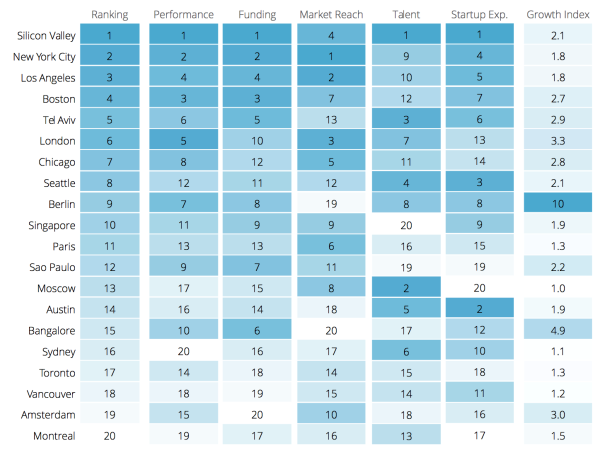
Four European cities made the cut: Amsterdam is enjoying its first appearance in the top 20 at number 19, Paris achieved an impressive 11th place, Berlin came in at an admirable 9th, and London remains the uncontested European heavy-hitter, at number 6.
Remarks BB : Achte auf den Anteil der Beteiligung ( in % ) versus der Bewertung
Airbnb, Uber, Snapchat oder Spotify: Die Zahl der
Start-ups, die mit einer oder mehr Milliarden Dollar bewertet werden,
hat sich im Vergleich zum Vorjahr fast verdoppelt. Ein Großteil davon
kommt - wenig überraschend - aus den USA. Doch auch Europa mischt mit.
Von wegen Einhörner gibt es nicht, sie werden sogar immer mehr. Als
"Unicorns" -Einhörner - werden Start-ups mit einer Bewertung in
Milliardenhöhe bezeichnet. Laut "Wall Street Journal"
werden aktuell 112 Start-ups von Venture-Capital-Firmen mit einer
Milliarden US-Dollar oder mehr bewertet. Im August 2014 waren es noch
64. Ihre Zahl hat sich als fast verdoppelt - und sie erreichen bereits
vor dem Börsengang extrem hohe Bewertungen.
Die zehn wertvollsten Einhörner
Name des Unternehmens
Bewertung in Mrd. US-Dollar
Beteiligungskapital in Mrd. US-Dollar
Letzte Bewertung
Uber
50,0
5,6
Juli 2015
Xiaomi
46,0
1,4
Dezember 2014
Airbnb
25,5
2,3
Juni 2015
Palantir
20,0
1,5
Juli 2015
Snapchat
16,0
1,2
Mai 2015
Flipkart
15,0
3,0
April 2015
Didi Kuaidi
15,0
3,0
Juli 2015
SpaceX
12,0
1,1
Jänner 2015
Pinterest
11,0
1,3
Februar 2015
Dropbox
10,0
0,6
Jänner 2014
Quelle: WSJ
Die drei wertvollsten Unternehmen sind derzeit der umstrittene
Fahrdienstvermittler Uber (50 Milliarden US-Dollar) der chinesische
Smartphone-Hersteller Xiaomi (46 Milliarden US-Dollar), und die Online-Bettenplattform Airbnb
(25,5 Milliarden US-Dollar). 73 der Unternehmen aus dem
Milliarden-Dollar-Start-up-Club sind in den USA beheimatet, weitere 27
stammen aus Asien. Dagegen kommen lediglich zehn aus Europa. Darunter
etwa der erfolgreiche Streamingdienst Spotify und die
Musikerkennungs-App Shazaam.
Last week, Inc. released its annual Inc. 5000
list, which ranks the fastest-growing private companies in America.
Here are the 10 fastest-growing companies in healthcare, along with
their overall Inc. ranking and a rundown of what they’re doing that may
be contributing to their rapid growth:
1. Castle Medical (#4): Over the last three
years, Castle Medical, an Atlanta-area company that provides drug
testing services for physicians, has grown by 25,485%. The company
specializes in drugs of abuse. Some of the services it provides include
drug confirmation testing, specimen validity testing, drug confirmation
urine testing and prescription drug monitoring.
Castle Medical has been the recipient of multiple awards over the
last three years. Perhaps most notably, it was named one of Atlanta’s
“Best Places to Work” for two straight years and also
won the Atlanta Journal-Constitution’s “Top Workplaces Award” for 2015.
It’s no secret that happy employees generally tend to be better workers. 2. Restore Health (#8): Restore Health has seen a
three-year growth of 21,753%. The company, which is located in Madison,
WI, provides personalized and specialty medicines to healthcare
providers and their patients. It offers a number of products and
services, including a full-service specialty pharmacy, a clinical and
analytical chemistry laboratory and a clinical services and support
group.
Restore Health prides itself on “constantly seeking partnerships with
the industry's leading advocates, providers and educators” in order to
further its goal of “providing the best, most innovative personalized
healthcare solutions to patients and providers.” 3. Seeking Health (#37): Based in Bellingham, WA,
Seeking Health has grown by 6,181% over the last three years. The
company sells nutritional supplements based on the premise that “if one
supports their body's systems with pure, highly absorbable,
well-formulated nutrients, the ability to remain healthy and vital
significantly increases.” It also provides education on dietary,
lifestyle, mental and nutritional needs and has an interactive Learning
Center where consumers can view health-related research articles,
podcasts, videos, blog posts, presentations and radio shows.
In today’s world where more and more people are seeking organic
products with no harmful additives, it’s easy to see where there would
also be a demand for all-natural nutritional supplements and related
educational materials. 4. BioPoint (#49): BioPoint, a pharmaceutical and
biotech consulting company in Wakefield, MA, has seen a three-year
growth of 5,302%. The company’s consultants have specialized expertise
in drug safety, health economics and outcomes research, regulatory
affairs, quality assurance, compliance and risk mitigation.
"We've worked tirelessly to build relationships with key
professionals across the entire life sciences spectrum, all as part of
delivering tremendous value to each and every client," Co-founder Chris
Nash said in a statement. "Life sciences is all we do," said BioPoint
Co-founder Edwin Matos. "Our industry focus, along with an emphasis on
providing the highest level of customer service to our consulting base
and vendors, has allowed us to rocket to the top of our niche." 5. FITBIT (#53): San Francisco-based FITBIT, a
company that sells fitness products to track activity and performance,
has grown by 5,057% over the last three years. The FITBIT devices, which
can be synced to a computer or smartphone, track things like number of
steps taken, distance walked, calories burned and progress toward goals.
Their success is likely due to the fact that they tend to motivate
people to be more active, and therefore healthier. 6. Clinical Ink (#57): Clinical Ink of Horsham,
PA, has seen a three-year growth rate of 4,614%. The company is
dedicated to eliminating paper documentation in clinical research
through its SureSource platform. Clinical Ink claims that eliminating
the problems and complexities associated with traditional paper-based
technologies will help ease the burden of clinical research, which will
dramatically reduce clinical trial costs, complexities and cycle times.
“Our solutions address the single biggest problems of clinical
research – data capture during the patient visit, remote monitoring of
research site documents, immediate data availability, and streamlining
workflows for research sites,” CEO Ed Seguine said in a statement. 7. Physicians Toxicology Laboratory (#59): Over
the last three years, Tampa-based Physicians Toxicology Laboratory, a
specialized laboratory that does routine urine drug testing to rule out
illicit drug use or non-compliance with prescribed drug regimens, grew
by 4,415%. The company claims it can protect physicians from
prescription-related liability while also keeping patients safe. It also
boasts seamless integration with electronic medical records systems. 8. Cognitive Medical Systems (#95): Cognitive
Medical Systems of San Diego, which specializes in clinical decision
support systems, has seen a three-year growth rate of 3,499%. The
company has “extensive experience building custom solutions for
large-scale and complex projects that are compliant with Federal and
Military standards.” In 2015, Cognitive Medical Systems was named one of
San Diego’s “Best Places to Work” by the San Diego Business Journal. 9. freshbenies (#117): Based in McKinney, TX,
freshbenies has grown by 2,999% over the last three years. The company
sells membership cards that provide access to a variety of services,
including telemedicine consults, a medical health advisor, lower
prescription costs, dental care, vision care and others. According to
The Dallas Morning News, freshbenies was developed to help small to
mid-size companies provide benefits to employees with higher-deductible
plans or no insurance at all. The benefits include health services that
are not covered under the Affordable Care Act.
10. VitalWare (#123): VitalWare, a company that
provides cloud-based technology services out of Yakima WA, has seen a
three-year growth rate of 2,938%. The company’s mission is to empower
providers and partners to realize revenue cycle success through
innovative documentation, coding, billing and auditing solutions. It was
founded in 2011 “to help organizations with the overwhelming task of
navigating the many regulatory changes taking place in today’s
healthcare environment.”
Services splint strains and suture wounds
on-site; Are house calls better than ER visits?
Source : Melinda Beck, The Wall Street Journal
Darren Gold had a stomach virus the first time he used an app
called Heal to summon a doctor to his Beverly Hills home. He liked the
Stanford-trained doctor who showed up so much that he called Heal again
when his 2-year-old son had a fever, and again when the whole family had
colds.
The charges—$99 each for the first two visits; $200 for
the family—weren’t covered by insurance, but Mr. Gold, who owns a
corrugated-box company, says that was still a bargain compared with
taking time off work to go to the doctor. “Now, whenever my son bumps
himself, he says, ‘Daddy, we need to get the doctor here,’ ” Mr. Gold
says.
Heal is one of several startups putting a high-tech spin on old-fashioned house calls—or
“in-person visits,” since they can take place anywhere. The services
provide a range of nonemergency medical care—from giving flu shots to
treating strep throats and stitching lacerations—much like a mobile
urgent-care clinic.
The companies use slightly different models.
Pager, in New York City, dispatches doctors or nurse practitioners via
Uber, for $200. Heal, in Los Angeles, San Francisco and Orange County,
Calif., promises to “get a doctor to your sofa in under an hour” for
$99. (A medical assistant goes along to do the driving and parking.)
RetraceHealth,
in Minneapolis, has a nurse practitioner consult with patients via
video (for $50), and only comes to their homes if hands-on care like a
throat swab or blood draw is necessary (for $150).
An Uber-type service to allow
doctors to make house calls? There’s an app for that. Pager.com Chief
Technology Officer Oscar Salazar and WSJ’s Tanya Rivero discuss the
site’s service to doctors and patients and its newest round of funding.
Photo: Pager
Atlanta-based MedZed sends a nurse to a patient’s home to do a
preliminary exam. Then the nurse connects via laptop with a doctor who
provides a treatment plan remotely. Several Atlanta practices use MedZed
as a way to offer patients extended hours without having to keep their
offices open.
Most of the services don’t accept insurance, but
they say patients can pay with health savings accounts or submit
out-of-network claims. Such ventures are fueled by a confluence of trends,
including growing interest in the so-called sharing economy, where
technology connects providers with excess capacity and consumers who
want on-demand services. Many doctors and nurses who work for hospitals
are eager for extra work in their off-hours, the companies say. The
services carry malpractice insurance, but say overall low overhead keeps
prices down.
And thanks to the boom in mobile-medical technology, providers can carry key equipment with them, from portable blood analyzers to hand-held ultrasounds.
The
companies are attracting venture-capital investment and partnerships
with hospital systems, which increasingly see in-home care as a way to
reduce unnecessary ERs visits and readmissions.
Health systems “are experimenting with many different options to get patients the right level of care,” says Pam Nicholson,
senior vice president for strategic initiatives for Centura Health,
Colorado’s largest hospital chain. Centura is teaming up with True North
Health Navigation, a Denver startup that offers on-scene care to 911
callers as an alternative to a costly ambulance ride to the ER. Centura
plans to offer True North’s home-care services to its own employees and
other patients whose costs it is responsible for under insurance
contracts.
House calls, which accounted for 40% of all doctor
visits in 1930, dwindled to less than 1% by 1980 as physicians found it
far more efficient to see 20 or 30 patients a day in an office than just
a handful in their homes. But in-home care is starting to be seen as
cost-efficient again—particularly for the most expensive patients. A
pilot project providing in-home care for 8,400 Medicare patients with
multiple chronic-conditions cut costs by more than $3,000 per patient,
the agency reported in June.
Analysts say it’s unclear whether
many of the new on-demand services will reduce costs for those
chronically ill patients—or mainly make it more convenient for the
healthy and wealthy to get care they could have gone without.
Pager,
which has treated about 5,000 patients in New York’s five boroughs
since its founding last year, says a typical patient is a young mother
with one sick child and others she doesn’t want to bring along to the
doctor’s office too or leave at home. “Health checks,” in which a nurse
does cholesterol, blood pressure, blood sugar and other tests for $75,
are also popular—even in office settings.
On one such visit recently, Kunal Merchant,
a 34-year old Facebook executive with a new baby on the way, wanted to
be sure he was healthy, but didn’t want to take hours off work to visit a
primary-care physician he barely knew. So he booked an office
conference room, and scheduled a Pager visit. Registered nurse Eve
Rorison brought all the gear she needed to check his blood sugar, blood
pressure, cholesterol, heart rate and BMI, in her backpack. About 15
minutes and one finger prick later, she declared, “You’re very
healthy—keep up the good work.”
Many of the services bill themselves as an “Uber for
health-care”—but to date, they haven’t sparked the kind of opposition
from traditional doctor practices that the ride-sharing service has from
taxi drivers. That’s in part because the house-call companies are new
and small and in part because they employ licensed medical
professionals—generally doctors, nurses and nurse practitioners with
experience in primary care or emergency medicine, looking to earn extra
money in their spare time. The providers generally take home about half
of the house-call fee, and make fewer than 10 calls a day. But many say
they enjoy the chance to take their time with patients. “I love my Pager
shifts—it’s back to real medicine, just you and the patient,” says
Kimberly Henderson, an ER physician at Beth Israel Hospital in New York
who works for Pager one or two days a week.
Still, Alan Ayers, a
spokesman for the Urgent Care Association of America, a trade group,
says urgent-care clinics provide all the same services that the
house-call companies do, far more efficiently. He also asks, “What
quality control is there over the clinical environment in someone’s
home? Does it have the right light? Is it sanitary?”
What’s more,
some office-based physicians fear that dialing up doctors like taxi
rides will further fragment health-care delivery and interfere with
doctor-patient relationships. “Someone who knows you well might say,
‘Why would you need to be seen three times in four weeks for a cold?
Maybe it’s really heart failure’,” says Robert Wergin, president of the American Academy of Family Physicians, who practices in rural Milford, Neb.
The
on-demand house-call companies counter that they will send reports to
patients’ regular physicians on request. They also say that most people
who try the services become repeat users. “Once you’ve had pizza
delivered, you rarely go pick up pizza again,” says Thompson Aderinkomi,
a health-care economist who founded RetraceHealth in 2013.
House-call
providers also say that even if conditions aren’t ideal, they get to
know patients far better seeing them at home than they would in a
hurried office or ER visit.
Caren Misky, a nurse practitioner
with True North Health Navigation in Denver, says she recently responded
to a call where an Alzheimer’s patient had fallen and cut his head. She
was able to staple his wound at the kitchen table while he had
breakfast. “His wife said the last time that happened, they spent eight
hours in the ER and had a $10,000 bill,” Ms. Misky says.
True North is one of the few services that is reducing ER use. It was founded in part because local fire chief Rick Lewis
wanted to offer 911 callers who had minor, nonemergency health issues
an alternative between no care and a costly ambulance ride to the ER.
Now,
if the 911 dispatcher determines that the caller has a low acuity case,
the True North mobile unit goes to the scene along with the fire
department’s paramedics. Once the paramedics confirm the situation isn’t
life-threatening, the caller can choose between being treated by a
nurse practitioner on the spot, for $200 to $300, (which is covered by
most Colorado insurance plans) or going by ambulance to the ER, which
typically costs $3,000 or more.
“You essentially get the same
person who would see you in the ER, with a lot of the same equipment,
for a lot less money than you’d pay there,” says Chief Lewis.
True
North, which is changing its name to Dispatch Health, is expanding so
that Denver residents can summon at-home visits via phone, app or Web
without calling 911.
CEO Mark Parther says his teams have
treated about 400 911 callers who would otherwise have gone to the ER
since 2013. He adds: “We get a thank-you note every week.”
USA,
India, and China are the top markets for funding to e-commerce
startups. Together, they account for 62% of global deals and 71% of
total funding going to e-commerce startups.
With over 950 e-commerce deals, the US drives 5x more deals than
India and China, but US deals tend to be smaller funding rounds. China
actually drives a slightly higher share of global funding than the US,
despite accounting for just 9% of global deal flow. A few more data
points:
Chinese e-commerce companies received the most funding, about $9.9B
dollars over 188 total deals. This is a higher total funding amount than
the US market, and translates to $53M per deal. That’s also a
considerably higher average deal size than what the US and India are
seeing.
The US market has seen $9.8B invested over 962 deals, for an average
of $10M per deal, less than one-fifth of China’s deal size. That said,
the US market drives extremely high deal volume and accounted for 45% of
global deals.
India lags the two leading markets, with $5.6B invested over 184
deals, for an average of $30M per deal, which is about 3x the deal size
seen in the US market, but significantly smaller than the deal size of
China.
Other major players are Germany with $2.8B invested over 168 deals, and the UK with $1.2B invested over 98 deals.
The chart below shows each of the major countries’ breakdown of deal
type by dollar share, revealing an emphasis on late-stage funding in
several markets.
The US market saw an even distribution with about 34% of dollars
going to late-stage investments, and 21% to early-stage rounds (somewhat
bucking the general global trend toward lopsided dollar-share held by
the late stage).
In India, about 66% of total dollars went to late-stage investments in companies such as Flipkart, Quickr, and Snapdeal.
This is a lot higher than the regular distribution to late-stage
investments. Additionally, only 4% of dollar funding went to early-stage
investments.
China and Germany had a similar and more usual investment-stage
distribution with around a 40% dollar-share for late-stage investments,
and less than a 10% share for early-stage investments. Some major
late-stage Chinese investments include Jingdong, Dianping and Uxin Pai.
Note: For this analysis, we focused solely on companies selling
physical goods. We excluded e-commerce startups focused on services or
digital goods (e.g., video, apps, and music).
Opinion Article by Dr. Guy Wood-Gush, CEO of Deontics.
Comment: Actual technology developments in AI, machine learning, deep learning on the one side , and lowering prices for cloud services, hardware devices on the other side prepare the ground for quicker deployments as known from the past. So watch out !
A turning pointing for artificial intelligence (AI) came when the
computer Deep Blue beat world champion Garry Kasparov at chess 18 years
ago. Since those early days some of the best minds have been working on
applying AI in medicine. Today, I'd like to see where AI could take us
in clinical practice.
Here's a scenario. A man falls down in the street clutching his chest.
An ambulance arrives armed with the latest tools in AI, and takes
multiple streams of data to look for patterns.
Paramedics make their initial observations, speaking directly into a
voice recognition system that picks up the salient data points from his
natural language, such as name, GP, date of birth, symptoms and clinical
signs. The system starts to look for the patient's GP record and
medical history, and any clinical notes from local hospitals. The crew
measure and record blood pressure, pulse, and O2 saturation. The devices
they carry immediately start to show differential diagnosis, with
probabilities, and recommend next steps.
Back at the hospital, the data are accessed. Clinical indicators at the
scene and the GP record are pointing towards a myocardial infarction
(MI). Which pathway should the patient start at hospital?
The admitting doctor agrees that MI is likely and implements an ECG and
chest x-ray. A single click orders all relevant tests and records the
fact that the patient is diabetic. In addition to the MI pathway, the
patient is automatically entered on the diabetes comorbidity pathway and
the patient's blood sugar is evaluated against historical personal
data. The system immediately sends out a clinical alert that the
patient's blood sugar is dangerously low and needs intervention.
On arrival, the doctor dictates a clinical assessment into a voice
recognition system that recognises and records relevant data items. It
confirms a suspected MI, and implements the recommended actions to
address low blood sugar.
All the time, data in the clinical AI system are building. The system
interprets the ECG and the chest x-ray, automatically finding a pattern
that is consistent with chronic cardiac damage from hypertension. The
system recommends cardiac catheterisation as the next step and the
doctor confirms this. Patient-specific antihypertensive therapy is
recommended.
So how is this fundamentally different to what doctors do here and now?
Is this human versus machine? And is the medical Deep Blue about to beat
the human clinician?
The fundamental difference is that AI adds a layer of analytics and
automation to medicine that removes the need for duplication, reduces
error, and drives patients towards the correct pathways while avoiding
the danger of missing unusual diagnoses.
It makes sure that the right things happen to the patient at the right
time, in the right place, and in the right order, and reduces
unwarranted variation in clinical practice. It brings together clinical
data with guidelines and allows clinicians to make the best-informed
decisions for each individual.
This is human plus machine and I would argue that it equals better medicine.
With AI, the role of the doctor changes to become more like the pilot of
a modern aeroplane. The computer does a lot of the flying but the plane
still needs the pilot.
The doctor can be released from the paperwork and spend more time with
the patient. AI enables the patient to join in shared decision making
based around the same evidence as clinicians.
Early AI systems relied on coding and structured logic; but people are
unique. Advanced AI can provide a smarter approach that starts from
where the patient is now and changes as the patient's parameters change.
Think of it as a 'sat nav' for medicine.
Fundamentally clinical logic has to be modelled accurately using a
clinical logic language such as Proforma, which was explicitly designed
around a patient safety and quality agenda.
So what of this scenario already exists? Algorithms that can interpret
chest x-rays and ECGs are out there. Proforma-based tools can already
match clinical parameters against clinical guidelines and extract the
correct patient pathway. It's already being used here in the UK and the
US for oncology, cardiovascular care, diabetes and other conditions. All
medicine will be affected by the AI technology.
Plus the wealth of data that emerges can support audit, research and
help provide the analysis for continuous improvement. But it makes most
difference when it helps a doctor treat a patient.
I really do not believe that computers and AI will ever take over from
doctors. But I do believe that clinical medicine can be dramatically
improved - in quality, safety and efficiency terms - and AI is the tool
we need to achieve this.
The 40 companies have been
selected by two Selection Committees made up of Investors as well as
representatives from Life Science companies. The selected companies will
be presenting at the Healthtech Summit in Lausanne to an audience of
over 200 people, including Venture and Private Equity investors
collectively representing $40Bn in invested assets, Business Angels and
Life Sciences companies, among whom the No 1 Pharma company, the No 1
food company and No 1 Med Tech company.
Close to 200 nominations were received, 123 companies have applied and
the Selection Committees have spent several months rigorously screening
and choosing the final 40. Companies were chosen according to the
uniqueness of their solutions, the strength of their business model,
their capability to execute on the business plan and the quality and
track record of their management teams.
Of the top 40 companies, 4 are seed stage; 21 are start-ups; 14 are in
expansion/growth stage and 1 company is late stage/pre-IPO. In terms of
the countries represented the breakdown is as follows: Denmark (1);
Finland (1); France (3); Germany (7); Ireland (1); Israel (1); Italy
(1); Netherlands (1); Portugal (1); Spain (4); Sweden (1); Switzerland
(10); UK (5).


 Last week, Inc. released its annual Inc. 5000
list, which ranks the fastest-growing private companies in America.
Here are the 10 fastest-growing companies in healthcare, along with
their overall Inc. ranking and a rundown of what they’re doing that may
be contributing to their rapid growth:
Last week, Inc. released its annual Inc. 5000
list, which ranks the fastest-growing private companies in America.
Here are the 10 fastest-growing companies in healthcare, along with
their overall Inc. ranking and a rundown of what they’re doing that may
be contributing to their rapid growth:

